

Introduction to Stud Welding
Stud welding is a critical process in modern steel construction, used to create composite action between steel beams and concrete slabs. This guide explains how stud welding works, when it’s required, and why it’s essential for structural performance in metal decking systems.
When is Stud Welding Required?
Stud welding is required when composite action between the steel beams and concrete slab is needed.
In most steel decking systems, shear studs are welded through the metal deck into the supporting steel beams. This allows the steel and concrete to act together as a single structural unit, significantly increasing load capacity and stiffness.
However, if the metal decking is only being used as permanent formwork — for example, to support a non-composite slab — stud welding may not be necessary.
The requirement for stud welding ultimately depends on the structural design and whether composite performance is specified.
In the UK, requirements are typically defined by structural engineers in accordance with Eurocode 4 (Design of Composite Steel and Concrete Structures).
How Stud Welding Works
This involves attaching metal studs to another metal surface using an electric arc. This arc heats the stud’s tip until it melts, allowing it to fuse seamlessly with the base metal.
This process is known for its strength and efficiency, making it a preferred choice in construction.
For effective welds that work, the metal deck should be in contact with the beam, there can be absolutely no bumps, such as rivets or uneven surfaces.
This project exemplifies RMD Profiles’ commitment to delivering tailored composite decking solutions for residential construction.
From detailed layout design through to on-site installation, our Supply & Fix service ensures each decking package meets the exacting demands of every client and project.
Process of Stud Welding
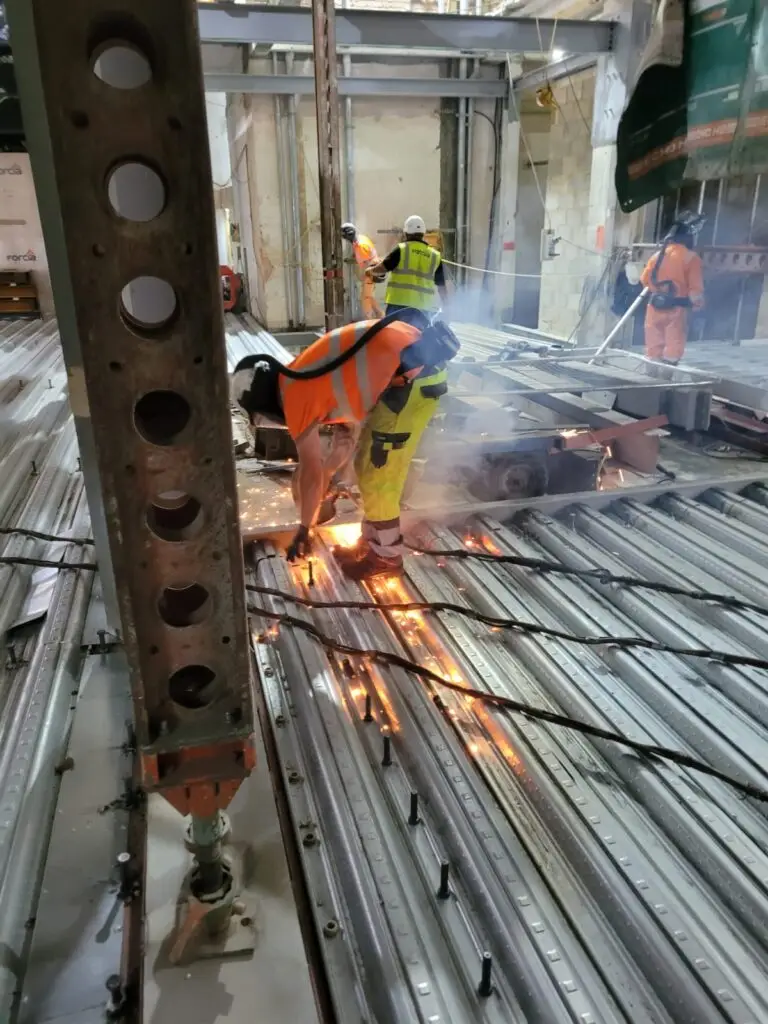
Often referred to as shear stud welding, is a fast and efficient method used to attach steel studs to structural steel beams. In metal decking systems, this process is typically carried out through the deck to create composite action between the steel frame and concrete slab.
The process involves several key stages:
1. Preparation: The steel beam surface must be clean and free from coatings, rust, or debris. Good contact between the stud and base metal is essential for a successful weld.
2. Positioning: Shear studs are placed in a stud welding gun and positioned accurately on the steel beam, usually through the metal decking profile.
3. Arc Creation: An electric arc is generated between the stud and the steel surface. This rapidly heats both materials to a molten state.
4. Weld Formation: The stud is forced into the molten pool, fusing it with the steel beam. This creates a full-strength bond in a matter of seconds.
5. Cooling and Solidification: The molten metal cools quickly, forming a strong, permanent connection capable of transferring shear forces.
Stud welding is typically carried out on-site using specialist equipment, allowing large numbers of studs to be installed quickly and consistently across a floor plate.
Site Considerations
When planning stud welding works, factors such as access for welding rigs, earthing requirements, and surface conditions must be considered. In some cases, painted or coated steel may require preparation before welding can take place.
Benefits of Stud Welding
- Structural Strength & Composite Action: Stud welding creates a strong mechanical bond between steel beams and concrete slabs, allowing them to act as a single structural unit. This significantly increases load capacity and overall structural performance.
- Fast & Efficient Installation: Studs can be welded quickly on-site, often through metal decking, reducing installation time and minimising labour costs compared to alternative fixing methods.
- Versatility in Steel Construction: Stud welding is widely used across steel decking and composite floor systems, making it suitable for commercial, industrial, and infrastructure projects.
- Improved Load Distribution: Shear studs help transfer loads efficiently between materials, reducing stress concentrations and improving the stability of the structure.
- Reduced Material Requirements: By enabling composite action, stud welding can reduce the amount of steel required in beams, leading to cost savings and more efficient structural design.
Applications in Construction
Stud welding is particularly beneficial in heavy-load applications such as:
- Bridges and Buildings: Providing strong, reliable connections that support heavy loads.
- Composite Construction: Integrating metal decking with concrete slabs for a unified structure.
Stud Welding in Metal Deck Design
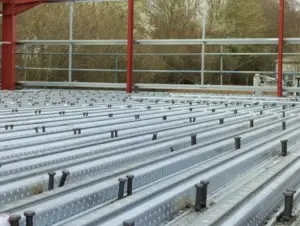
Stud welding is especially applicable in metal deck design for its ability to create strong, composite floor systems. By welding shear studs through the metal decking to the supporting steel beams, the composite action between the steel and concrete is maximised, resulting in a stronger, more efficient floor system, and structural frame saving overall weight in steel compared to conventional methods of building, thus saving time and money in the foundations.
The shear stud enhances composite action by effectively transferring load-bearing forces between materials. It resists horizontal shear through its shank and prevents vertical uplift with its head. Consequently, the resulting composite floor slab is stronger and capable of supporting heavier static and dynamic loads compared to each material alone, while maintaining a relatively lightweight structure.
Benefits of Using Studs in Building Design
Using studs in building design offers several advantages:
- Enhanced Load Distribution:Shear studs help distribute loads more evenly across the structure by transferring forces between the steel beams and concrete slab, reducing stress concentrations and improving overall stability.
- Improved Structural Integrity: The connection created through stud welding enables the steel decking and concrete slab to act as a single composite unit, significantly enhancing the building’s structural integrity.
- Reduced Material Usage: By enabling composite action, stud welding allows for more efficient structural design, often reducing the amount of steel required without compromising strength, resulting in cost savings.
- Flexibility in Design: Stud welding supports longer spans and more open floor layouts, giving engineers and architects greater flexibility in building design.
Applications in Construction
The Role of Stud Welding in Composite Action
Stud welding plays a crucial role in achieving composite action between the metal deck and the concrete slab. Here’s how:
- Shear Connectors: Metal studs, welded through the metal decking to the steel beams below, act as shear connectors. These connectors ensure that the steel beams and the concrete slab work together as a single unit.
- Load Transfer: The studs transfer horizontal shear forces between the concrete slab and the steel beams, ensuring that they move together under load. This maximises the composite action and improves the overall strength and stiffness of the structure.
- Enhanced Performance: By preventing the concrete slab from slipping over the steel beams, stud welding enhances the performance of the composite floor system, allowing for greater load-bearing capacity and structural efficiency.
In summary, stud welding is essential for creating a strong, cohesive bond between the metal deck and concrete slab, which is vital for the structural integrity and effectiveness of composite floor systems.
Conclusion
Stud welding is a cornerstone of modern construction, offering unparalleled strength, efficiency, and versatility.
At RMDP, we leverage this technique to deliver superior construction solutions that meet the highest industry standards. WIth composite design engineers can save tons of steel overall and if considering the transfer loads into the foundation design the overall weight saving is significant.
Engineers must refer to proven design standards outlined in Eurocode 3, Design of Steel Structures, and Eurocode 4, Design of Composite Steel and Concrete Structures. Let us know if you need copies of these papers.
HVB – is Hilti Shear connectors an alternative to stud welding?
If it is difficult to position a stud welding rig next to the steel frame that needs to be earthed, or if the top flanges of beams are painted with high lead content paint, consider using Hilti HVB. This solution is suitable for small projects or areas with limited stud requirements.
However, HVB offers less than half the shear capacity of shear studs, requiring two to three HVBs to match one shear stud’s performance. Given the higher cost per HVB, this option can be expensive for large projects. Consult with our team to determine the best approach.
Here is an example of one of operatives shot firing the X-HVB into the steel.
IF you want to use metal deck for formwork or composite design, its easy to obtain. Just send us your structural GA or sketch out the dimensions showing us from point to point you are measuring and we will provide a calculation and profile recommendation that will be a great start point.
Read about metal deck here https://rmdp.co.uk/steel-decking-guide/
To download any papers for engineering decking into your project follow this link to the SCI https://www.steelconstruction.info/Composite_construction
RMDP Profile’s Commitment to Excellence
At RMD Profiles, we prioritise safety and precision in our stud welding practices. Our experienced team uses state-of-the-art equipment and adheres to stringent safety protocols, ensuring every weld meets the highest standards