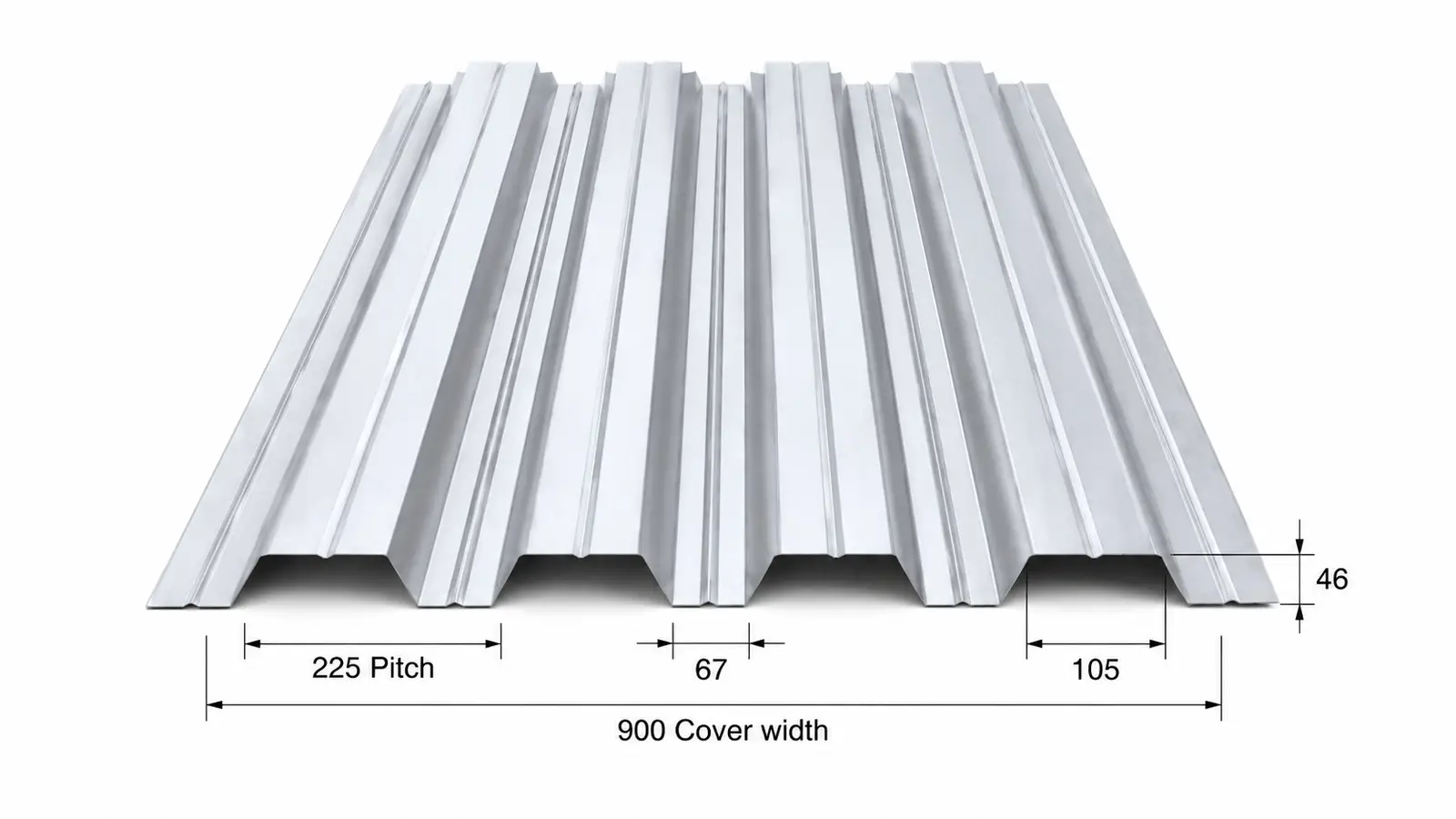

The RoofDek D46 is a mid-range steel roof decking system for medium-span applications engineered for medium-span commercial and industrial applications. At 46mm profile depth with 100mm bearing width, D46 represents a significant step up from the RoofDek D32S and RoofDek D35 profiles, delivering higher load capacity, greater stiffness, and longer clear spans.
D46 is available in two distinct configurations: solid tray for maximum structural performance, and web perforated for acoustic applications. Both variants use identical profile geometry and material options – choose based on your project’s acoustic and performance requirements.
Available in: Steel grades S220 and S280, plus Aluminium Rp0.2 165. Colorcoat pre-finished options available single or double-sided on steel grades.
Why specify RoofDek D46?
- 100mm bearing width eliminates need for beam seats on narrow purlins
- Spans from 1.00m to 4.00m in solid configuration
- Multiple gauge and material options for cost and performance optimisation
- Web perforated variant (pattern 4546) for integrated acoustic control
- Established profile with extensive design data and case history
RoofDek D46 prices start from £16/m² (supply only), depending on specification, gauge, and order volume.
RoofDek D46 Typical Applications
Commercial Offices
Mid-rise office buildings with medium-span roof structures. Web perforated D46 ideal for open-plan spaces requiring acoustic benefit.
Retail & Shopping Centres
Single and multi-level retail. Solid D46 for clear spans over shop areas. Perforated for acoustic control in food courts and common areas. Ideal for medium-span structural roof decking applications
Light Industrial & Distribution
Warehousing and logistics facilities. Solid D46 spans over bays to 4.00m. Fast-track installation on purlin grids.
Education & Leisure
Schools, universities, sports halls. Perforated D46 absorbs reverberation in gymnasiums, halls, and teaching spaces.
Plant Rooms & Technical Spaces
Mechanical plant, electrical rooms, comms floors. Solid D46 for heavy loads and concentrated point loads.
Composite Floor Systems
Partial composite interaction with in-situ concrete fills. D46 tray strength allows lighter structural steel frame.
Why This Steel Roof Decking System Is Used
Solid RoofDek D46 – Structural Performance
- Achieves 4.00m spans in S280 0.90mm and heavier gauges, reducing secondary steel frame cost
- 100mm bearing width eliminates beam seats; sits directly on purlin top flange
- High moment capacity (up to 6.62 kNm/m in S280 1.16mm broad flange) suits composite and hybrid structures
- Available in S220 (economy) and S280 (premium) with multiple thicknesses for project economics
- Aluminium option (Rp0.2 165) where corrosion resistance required—coastal, food processing, chemical exposure
- Pre-finished Colorcoat HPS200 Ultra available for exposed soffit or architectural detail
Web Perforated RoofDek D46 – Acoustic & Environmental
- Pattern 4546 provides 46% open area in web with 4.5mm diameter holes at 6.3mm triangular centres
- Integrated acoustic absorption reduces reverberation—no need for suspended ceiling in many applications
- 10.7% of exposed soffit area is open, allowing sound transmission into cavity above deck
- Lighter weight than solid variant (reduces structural frame load)
- VCL positioning critical: must sit BELOW perforated tray (tray cannot act as vapour barrier when soffit exposed)
- When soffit enclosed by MF ceiling creating sealed void, VCL may sit above deck subject to design analysis
- Spans typically up to 3.00–3.40m depending on gauge; check section properties for project loads
System Benefits (Both Variants) RoofDek D46
- Rapid installation on purlin grid-minimal site welding or bolting
- Tray acts as working platform during construction
- Clear soffit-no secondary beams, reducing visual clutter and easing M&E runs
- Excellent fit for fast-track and design-build programmes
- Cost-effective-lower frame tonnage due to long spans and distributed load path
- Compatible with all standard roof finishes, thermal insulation, and ceiling systems
RoofDek D46 Key Technical Features
Profile Dimensions
- Depth: 46mm
- Cover width: 900mm
- Pitch: 225mm
- Trough width: 67mm
- Overall flange: 105mm narrow, wider broad flange option
- Bearing width: 100mm on purlin
Material Options
- Steel S220: 0.70mm thickness
- Steel S280: 0.70mm, 0.90mm, 1.16mm
- Aluminium Rp0.2 165: 0.90mm, 1.20mm
- Pre-finished: Colorcoat HPS200 Ultra (single or double-sided)
Load & Deflection
- Imposed load: Span/200 deflection limit
- Wind suction: Span/150 deflection limit
- Internal web shear: 34–88 kN/m solid (varies by material and gauge)
- End shear capacity: 4–14 kN/m for bearing connection design
Perforated Variant (4546)
- Hole size: 4.5mm diameter
- Triangular centres: 6.3mm
- Open area: 46% of web, 10.7% of soffit
- Absorption: Effective with acoustic insulation above
- Spans: 3.00–3.40m typical (check properties)
Installation & Jointing
- Side laps and end laps: Self-drilling screw fastening
- Bearing fasteners: 2–4 screws per support depending on design
- Speed of fix: Typical rates 8–12 m² per person per day
- Site preparation: Minor; minimal handling damage risk
Environmental & Compliance
- Fully recyclable steel and aluminium
- BRAAM and BRE environmental data available
- Complies with BS EN 14994 and relevant building standards
- Pre-finished options: VOC-compliant paint systems
RoofDek D46 Section Properties & Load Data
RoofDek D46 – Solid Configuration Steel Roof Decking
Span range: 1.00m to 4.00m. Properties based on 100mm bearing on purlin.
| Material | Design Thickness (mm) | Weight (kg/m²) | BF MoC (kNm/m) | BF MoI (cm⁴/m) | NF MoC (kNm/m) | NF MoI (cm⁴/m) | Internal Rw (kN/m) | End Rw (kN/m) | Shear (kN/m) |
|---|---|---|---|---|---|---|---|---|---|
| 0.70mm Steel S220 | 0.64 | 7.20 | 2.32 | 27.61 | 2.46 | 29.57 | 17.72 | 4.13 | 34.24 |
| 0.70mm Steel S280 | 0.66 | 7.20 | 2.89 | 28.04 | 3.12 | 30.73 | 21.40 | 5.02 | 41.73 |
| 0.90mm Steel S280 | 0.86 | 9.26 | 4.13 | 39.17 | 4.28 | 40.04 | 34.17 | 8.29 | 65.91 |
| 1.16mm Steel S280 | 1.16 | 12.37 | 6.62 | 53.98 | 5.80 | 53.98 | 57.79 | 14.59 | 88.90 |
| 0.90mm Aluminium Rp0.2 165 | 0.90 | 3.21 | 1.98 | 36.98 | 2.13 | 38.52 | 14.92 | 3.64 | 31.26 |
| 1.20mm Aluminium Rp0.2 165 | 1.20 | 4.28 | 3.02 | 50.07 | 3.10 | 52.87 | 24.71 | 6.27 | 49.27 |
BF = Broad Flange | NF = Narrow Flange | MoC = Moment of Capacity | MoI = Moment of Inertia | Rw = Reaction strength | Properties based on 100mm bearing width on purlin.
RoofDek D46 – Web Perforated (Pattern 4546) Steel Roof Decking
Span range: typically 1.00m to 3.00–3.40m depending on gauge and loads. Perforated pattern reduces section properties. Properties based on 100mm bearing on purlin.
| Material | Design Thickness (mm) | Weight (kg/m²) | BF MoC (kNm/m) | BF MoI (cm⁴/m) | NF MoC (kNm/m) | NF MoI (cm⁴/m) | Internal Rw (kN/m) | End Rw (kN/m) | Shear (kN/m) |
|---|---|---|---|---|---|---|---|---|---|
| 0.70mm Steel S220 | 0.64 | 6.26 | 2.21 | 26.45 | 2.32 | 28.29 | 6.62 | 1.45 | 10.04 |
| 0.70mm Steel S280 | 0.66 | 6.49 | 2.73 | 26.84 | 2.91 | 29.40 | 8.01 | 1.76 | 11.27 |
| 0.90mm Steel S280 | 0.86 | 8.35 | 3.93 | 37.59 | 4.04 | 38.31 | 12.94 | 2.93 | 23.75 |
| 1.16mm Steel S280 | 1.16 | 11.15 | 6.41 | 51.68 | 5.48 | 51.68 | 22.08 | 5.19 | 43.21 |
| 0.90mm Aluminium Rp0.2 165 | 0.90 | 2.89 | 1.84 | 35.42 | 1.92 | 36.48 | 5.66 | 1.29 | 8.66 |
| 1.20mm Aluminium Rp0.2 165 | 1.20 | 3.86 | 2.85 | 47.94 | 2.89 | 50.43 | 9.45 | 2.23 | 18.63 |
Web perforated properties based on pattern 4546 (46% open area). BF = Broad Flange | NF = Narrow Flange | MoC = Moment of Capacity | MoI = Moment of Inertia | Rw = Reaction strength. Properties reduced compared to solid D46 due to web perforations.
Design & Specification Considerations of RoofDek D46
Bearing & Support for Steel Roof Decking
D46 requires 100mm minimum bearing width. The profile’s broad and narrow flange options suit different purlin widths and moments. End reactions are typically handled via self-drilling screws (2–4 per support). For composite floors or concentrated loads, provide detail design for bearing stiffeners.
Composite Action for the RoofDek D46 Steel Roof Decking
D46 is designed for partial composite interaction with in-situ concrete fills. Shear studs or mechanical interlock methods ensure adequate load transfer. The broad flange options offer better composite performance; confirm with structural engineer for your specific concrete depth and strength.
Vapour Control Layer (VCL) – Critical for Perforated Deck
Perforated D46 with exposed soffit: VCL must sit BELOW the deck tray. The perforations allow interstitial condensation to form within the roof void if the VCL is above the deck. Position the VCL either on the structural deck below, or on the tray itself (below insulation). Ensure the soffit void is ventilated to prevent moisture accumulation.
Perforated D46 with sealed MF ceiling cavity: When a metal framed ceiling creates a discrete internal environment (not exposed soffit), VCL positioning may be more flexible. The MF cavity acts as a secondary boundary. However, confirm with building services engineer that the ceiling void is adequately ventilated and moisture paths are managed.
Solid D46: Standard VCL practice applies. Typically positioned above the insulation layer or as a separate underlay. No special requirements due to absence of perforations.
Thermal Insulation
D46 accommodates both rigid and semi-rigid insulation blankets. Typical build-ups range from 100mm to 200mm depending on Building Regulations and building use. Perforated deck benefits from permeable insulation above (mineral wool, polyester) to allow sound absorption. Ensure purlin spacing matches insulation width for efficient layout.
Wind & Suction Design
Deflection limits under wind suction are span/150. This often governs in high-wind locations. End shear capacity must be confirmed to resist uplift forces. Bearing screw quantity and quality are critical-undersized fasteners can fail in suction. Consult with structural engineer for coastal or exposed sites.
Acoustic Performance (Perforated Only)
Web perforated D46 achieves sound absorption via energy dissipation in the void above. Sound reduction coefficient (SRC) depends on cavity depth, insulation type, and membrane properties. Typical absorption ranges from 0.5 to 0.8 across speech frequencies (500–2000 Hz). Work with acoustic consultant to confirm performance target for your application.
Fire Rating
D46 (both solid and perforated) achieves European classification A2-s1, d0 under BS EN 13823. Combined with appropriate ceiling and insulation systems, A or B-s1, d0 building classification is achievable. Confirm fire strategy with building control and structural engineer.
Surface Finish & Durability
Bare steel: suitable for internal, dry environments. Where corrosion risk exists (coastal, humidity, chemical exposure), specify Colorcoat HPS200 Ultra pre-finished steel or aluminium. Aluminium Rp0.2 165 naturally resists corrosion without paint in most climates.
Fastening & Jointing
D46 is fastened with 5.5 x 25mm self-drilling screws (TEK or equivalent) at side laps and end laps. Bearing connections typically use 6.3 x 35mm or 6.3 x 40mm fasteners depending on reactions. Ensure screws pass through at least two layers. Do not use cut and crimp or mechanical push-lock methods on structural deck-screw fastening is essential.
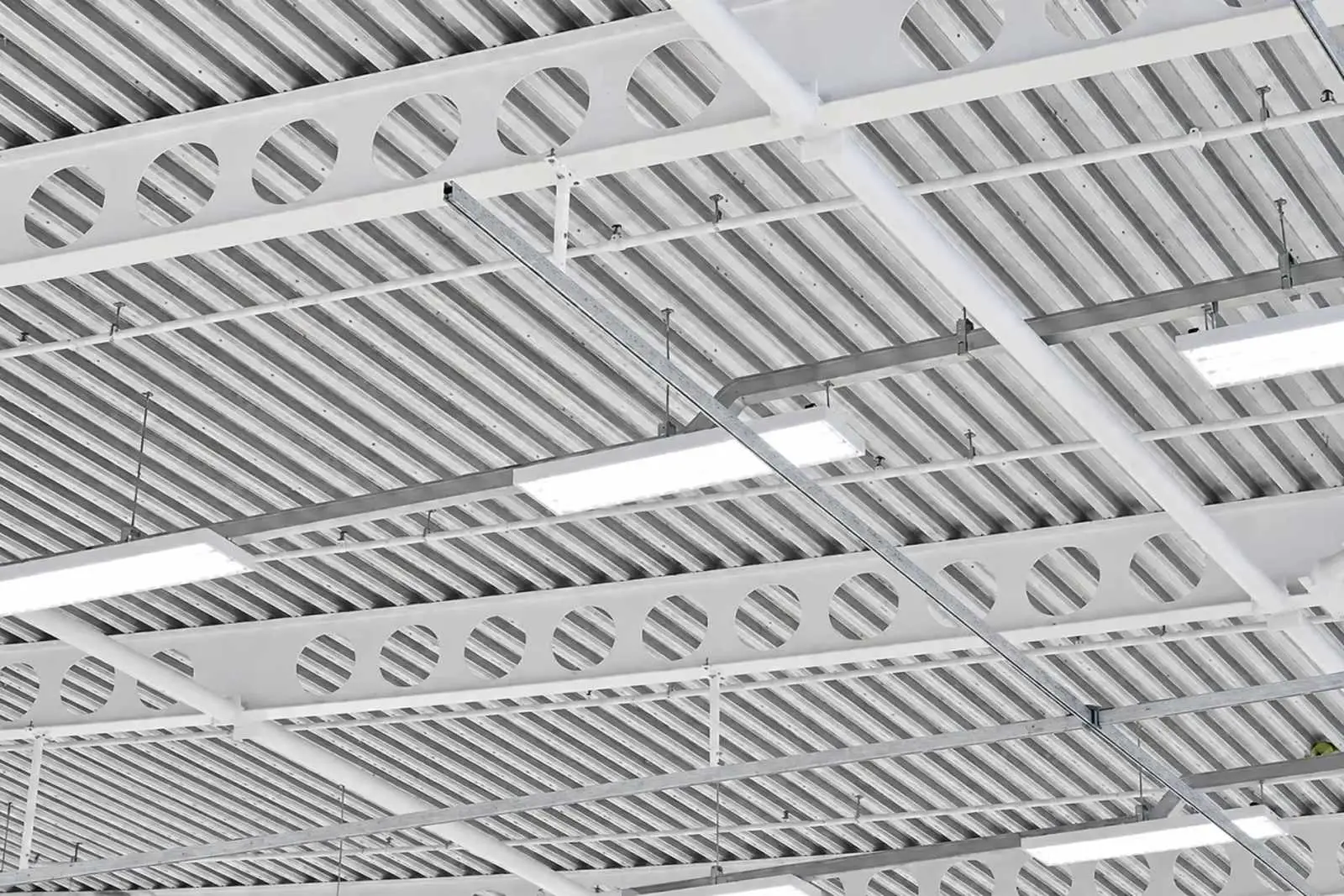
Installation Considerations for RoofDek D46 steel roof decking
Site Preparation RoofDek D46
- Purlin grid must be level and free of obstructions. Check purlin flange condition and width to suit D46 bearing requirements.
- If purlin flanges are twisted or uneven, minor shimming is acceptable. Do not exceed 20mm local variation.
- Confirm cover width specification (900mm) and pitch (225mm) align with purlin centres and roof layout.
- Delivery and unloading: D46 sheets are moderate weight (7–12 kg/m² depending on gauge). Standard crane and fork-lift handling is suitable.
Deck Laying & Fastening RoofDek D46
- Start laying from one eave, working up the slope. Establish straight first run to establish reference for subsequent sheets.
- Side laps: overlap one trough pitch (225mm). Secure with 2–3 fasteners per purlin span.
- End laps: 100–150mm overlap. Fasten with a minimum of 2 fasteners per side, 4 total per lap.
- Bearing fasteners: 2–4 self-drilling screws per purlin support depending on design reactions. Use 6.3 x 35mm or 6.3 x 40mm fasteners.
- Installation rate: 8–12 m² per person per day typical, depending on roof pitch, weather, and crew experience.
- Do not walk on deck after rain without fall protection. Tray can be slippery when wet.
Insulation & Services RoofDek D46
- Insulation blankets can be laid directly on deck. Use adhesive strips or lightweight battens to prevent wind uplift during construction.
- Perforated D46: place insulation directly above deck to allow acoustic absorption into void. Avoid complete sealing of soffit cavity.
- M&E services (pipes, ducts, cables) can run within the void space or across the deck surface. Ensure routes are coordinated with structural design and do not obstruct insulation.
- For exposed soffit finishes (perforated deck), confirm soffit panel supports do not restrict air flow through perforations.
Quality Control RoofDek D46
- Check fastener spacing and tightness on a sample of joints. Fasteners must be snug but not over-tightened (risk of stripping).
- Confirm all end laps are properly secured. Loose end laps can lead to movement and noise.
- Inspect for paint damage on Colorcoat finished deck. Minor scratches should be touched up to prevent rust creep.
- For perforated deck, visually confirm perforations are intact and free of blockages from dust or debris.
Post-Installation RoofDek D46
- Once deck and insulation are complete, install ceiling system, vapour control layer, or membrane as per design specification.
- Before final handover, confirm all fasteners are tight and that deck is free of debris.
- Provide site instructions on access for maintenance. D46 does not require routine servicing but perforations should remain clear of obstruction.
Common Problems This RoofDek D46 Steel Roof Deck System Solves
Too Many Beams & Columns
Shorter-span decking (D32S, D35) requires frequent secondary beams to limit deflection. D46’s superior stiffness spans up to 4.00m, eliminating internal beam lines and allowing clear floor or roof space.
Undersized Bearing Width
Older profiles use 65mm bearing width, requiring beam seats or bearing stiffeners. D46’s 100mm bearing width sits directly on narrow purlin top flanges without additional steelwork.
Excessive Reverberation
Hard metal decking reflects sound, causing echo in retail, offices, and leisure spaces. Perforated D46 absorbs sound through web perforations when backed with acoustic insulation-eliminating need for expensive suspended ceilings.
Cost of Suspended Ceilings
Metal framing, tiles, and hangers add expense and reduce headroom. Perforated D46 eliminates ceiling cost entirely while delivering acoustic performance-especially in cost-sensitive projects like education and retail.
Complex M&E Routing
Clear soffit void above D46 simplifies HVAC, electrical, and drainage runs. No secondary beams to route around. Perforated variant allows soffit exposure without acoustic penalty.
Corrosion Risk in Harsh Environments
Bare steel decking deteriorates in coastal, chemical, or humid settings. Specify Colorcoat HPS200 Ultra or Aluminium Rp0.2 165 for long-life performance without maintenance risk.
Exposure Cosmetics
Perforated RoofDek D46 in Colorcoat finish creates a finished architectural soffit-no drop ceiling needed. Ideal for car parks, industrial spaces, and designer warehouses where exposed structure is intentional.
Lightweight Load Transfer
Perforated D46 weighs less than solid (due to perforation reduction). When every kg matters in lightweight frame design, perforated variant lowers overall structure weight without sacrificing acoustic benefit.
RMD Profiles Services – Steel Roof Decking Experts
Technical Design Support
Our engineering team provides load tables, span guidance, and design checks for D46 projects. Confirm span capacity, bearing design, and composite interaction for your specific loads and constraints.
CAD & BIM Models
DWG and Revit models of D46 (solid and perforated) available for integration into project models. Reduces drafting time and ensures accurate representation in construction drawings.
Specification Writing
We draft performance specifications for tender documents, ensuring D46 is correctly specified in terms of grade, gauge, fastening, and finish. Reduces ambiguity and improves contractor pricing accuracy.
Acoustic Consultation
Perforated D46 performance depends on cavity depth, insulation, and membrane choice. Our acoustic advice ensures your specification achieves target sound reduction and absorption targets.
Installation Training
We provide on-site or digital training for contractors to ensure correct fastening, spacing, and handling. Reduces defects and rework, accelerating programme delivery.
Cost & Schedule Optimisation
We analyse your roof and floor structure to recommend the most cost-effective D46 gauge, material, and span arrangement. Balances structural performance against material and installation cost.
Fire & Compliance Certification
We provide test data, BRAAM/BRE evidence, and compliance statements for Building Regulations, planning conditions, and client requirements. Supports your certification dossier at completion.
Warranty & Durability Support
Colorcoat HPS200 Ultra and Aluminium Rp0.2 165 grades are backed by extended warranty. We advise on maintenance intervals, paint touch-up, and longevity expectations for your climate and building type.
Frequently Asked Questions of RoofDek D46
What is the difference between solid and web perforated RoofDek D46?
Solid D46 has a continuous web and delivers maximum structural performance: up to 4.00m spans, moment capacities of 6.62 kNm/m (S280 1.16mm broad flange), and full shear strength. Web perforated D46 (pattern 4546) has 4.5mm diameter holes at 6.3mm centres in the web, reducing section properties by approximately 5–10% but providing acoustic absorption when insulation is placed above. Perforations allow sound to transmit from the soffit into the cavity, where it dissipates in the insulation layer. Use solid D46 for structural-only applications; use perforated for projects requiring integrated acoustic control.
When should perforated RoofDek D46 be specified?
Specify perforated D46 when the project requires noise reduction and the soffit will be visible or exposed. Common applications include: open-plan offices, retail and shopping centres (food courts, atria), schools and universities, sports halls and leisure centres, library and study areas, healthcare facilities (wards, waiting rooms), and design-conscious warehouses where exposed soffit is architectural. Perforated D46 eliminates the need for a suspended ceiling system, saving cost and increasing headroom. If the soffit will be concealed by a sealed metal-framed ceiling, solid D46 is usually sufficient (but confirm acoustic requirements with building acoustician).
Where should the VCL (vapour control layer) sit with perforated D46?
This is critical. When perforated D46 soffit is exposed (not covered by a ceiling), the VCL must sit BELOW the deck tray. The perforations allow moisture to condense inside the roof void if VCL is above-causing rot and mould. Install VCL either on the structural deck below, or as a separate layer within the tray cavity, BELOW the insulation. Ensure the soffit void (between VCL and perforations) is ventilated via edge vents or soffit openings. When a metal-framed ceiling creates a separate enclosed cavity below the perforated tray, VCL positioning is more flexible-consult your building services engineer for the specific roof detail.
What bearing width does RoofDek D46 require?
D46 requires a minimum of 100mm bearing width on the purlin flange. This is wider than older profiles (D32S and D35 use 65mm). The advantage: D46 sits directly on narrow purlin top flanges without beam seats or bearing stiffeners. Ensure your purlin has at least 100mm of flange width in the bearing zone. If your purlin is narrower, consult with RMD for alternative solutions (e.g., reducing span, increasing purlin flange size, or specifying bearing stiffeners).
Can RoofDek D46 be specified in aluminium?
Yes. RoofDek D46 is available in Aluminium Rp0.2 165 grade in thicknesses of 0.90mm and 1.20mm (both solid and perforated). Aluminium D46 weighs approximately 55–60% less than steel of the same gauge, making it ideal for lightweight frame designs or where corrosion resistance is essential (coastal locations, food processing, chemical plants). Moment capacity is lower than steel (e.g., 1.98 kNm/m broad flange in 0.90mm alu vs. 4.13 kNm/m in 0.90mm S280 steel), so spans are generally shorter. Maximum span in 1.20mm aluminium is approximately 2.50–2.80m depending on loads. No paint finish required—aluminium naturally resists corrosion in most climates.
What span can D46 achieve?
Solid D46 spans from 1.00m to 4.00m depending on material, gauge, and imposed load. Example maximum spans: 0.70mm S220 (~2.50m), 0.70mm S280 (~2.80m), 0.90mm S280 (~3.80m), 1.16mm S280 (~4.00m). Perforated D46 spans are slightly shorter: approximately 3.00–3.40m in S280 0.90mm and heavier gauges, due to reduced section properties from the perforations. Wind suction often governs in high-wind locations-deflection limit is span/150 under suction, which can shorten allowable span. Aluminium grades typically span 2.00–2.80m depending on thickness. Always consult section properties tables and building loads (imposed load, wind, thermal) to confirm span for your project. RMD provides detailed span tables and design support.
Ready to Specify RoofDek D46?
Whether you need steel roof decking for a 4.00m span or integrated acoustic absorption for an open-plan office, RoofDek D46 delivers proven performance. Our engineering team is ready to support your project from initial design through to installation and handover.
Contact RMD Profiles today for technical design, CAD models, specifications, acoustic consultation, and cost optimisation.
RMD Profiles — Structural Metal Decking Systems and Steel Roof Decking