

Composite floor decking remains one of the fastest and most cost-effective ways to construct strong, code-compliant concrete floors in the UK. RMD Profiles design, supply and (if you want) install the leading systems from MetFloor, ComFlor and Firth, so you can match the profile to the job and keep your programme under control.
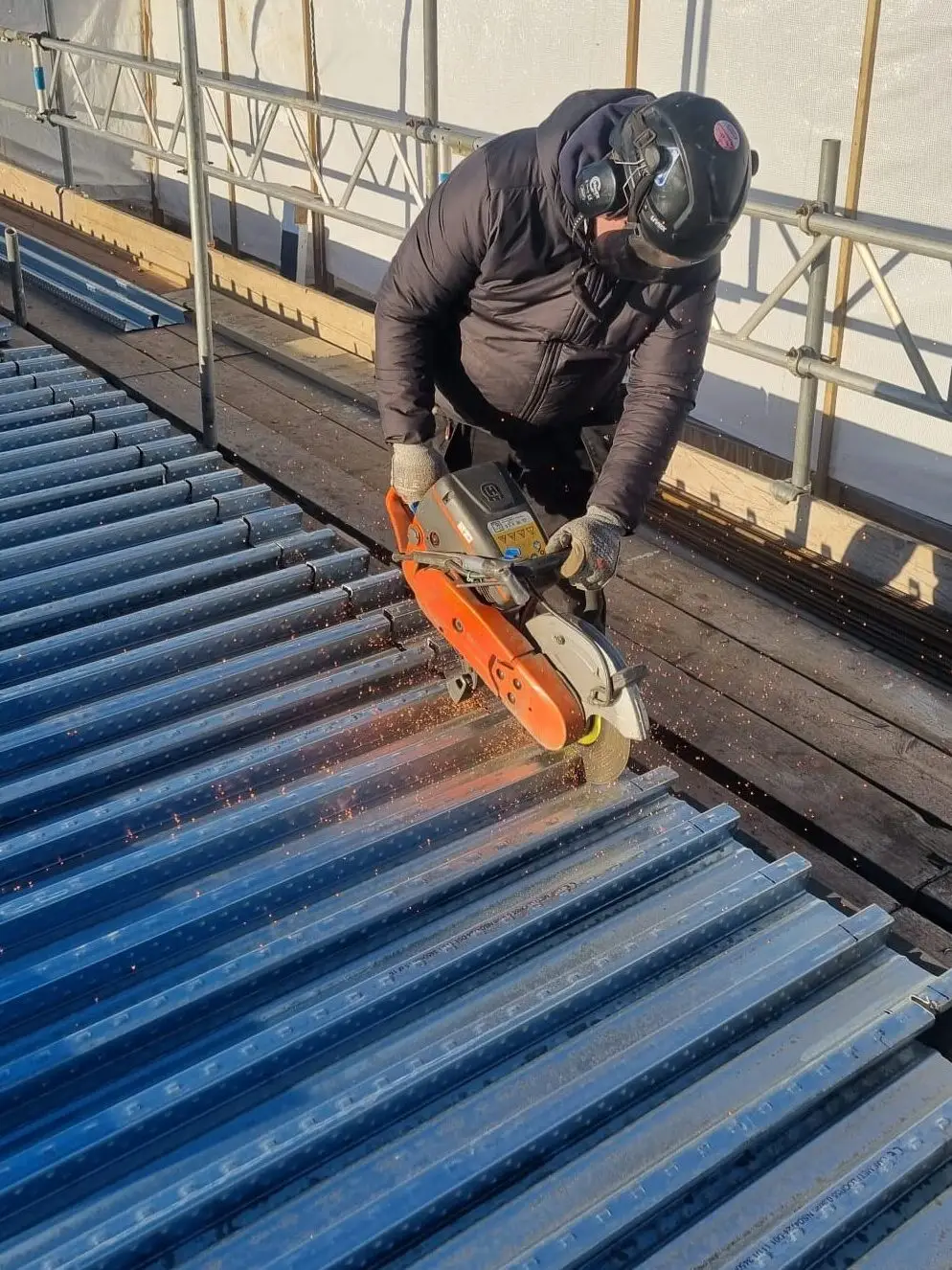
What Is Composite Floor Decking?
Composite floor decking uses profiled steel sheets as permanent formwork for an in-situ concrete slab. Once cured, the steel deck and concrete work together structurally to create a high-performance composite slab.
Benefits of Composite Decking
Faster Installation Programmes
Composite decking systems allow rapid floor installation and, in ideal conditions, experienced decking teams can install up to 400 m² per day.
Reduced Concrete Usage
The ribbed profile design reduces concrete volume compared to flat slabs, helping reduce dead load and improve structural efficiency.
Improved Fire Performance
Many composite floor decking systems can achieve up to two hours of fire resistance depending on slab depth and specification.
Safe Working Platform
Steel deck sheets create a stable working platform quickly after installation, supporting safer site operations.
Sustainable Construction
Composite floor decking uses recyclable steel and optimises material usage across large commercial projects.
Non-Composite vs Composite Decking Systems
Non-Composite Steel Decking
Used primarily as permanent sacrificial formwork for slab infills, mezzanine floors, and smaller structural projects.
These systems provide quick installation without requiring composite shear studs.
Composite Floor Decking with Studs
Composite decking systems use through-deck welded studs to connect the slab to the supporting steel frame.
This creates a stronger structural system that can:
- Reduce secondary steelwork
- Improve vibration performance
- Increase span capability
- Lower overall frame weight
Profiles such as MF60, MF80, CF60, CF80, and TR60+ are widely used across commercial steel frame construction.
Comparing MetFloor, ComFlor & TR60+
MetFloor Composite Decking
MetFloor profiles are widely specified throughout the UK for commercial composite slab construction.
- MF60 is ideal for standard commercial floors
- MF80 supports longer spans and reduced secondary steelwork
- Reliable detailing and strong UK availability
ComFlor Floor Decking
ComFlor systems offer multiple profile depths and cover widths.
- CF46 increases installation speed on large floor plates
- CF60 and CF80 provide excellent span capability
- CF100 is ideal for deep deck applications and higher loading requirements
TR60+ Composite Decking
TR60+ is popular on large commercial projects because of its wide 1000 mm cover width, helping reduce installation time and sheet quantities.
TR80+ provides longer span performance, while re-entrant profiles remain useful for shallow floor zones and specialist detailing.
What it is and why it speeds you up
Profiled steel sheets act as permanent formwork for an in-situ concrete topping. Once cured, steel + concrete act together as a composite slab. Benefits you can bank on:
- Programme wins: in best-case conditions (single level, square floor plate, clear crane access, minimal penetrations and no propping), one crew can lay ~400 m²/day.
- Less material: the ribbed shape reduces concrete volume and often trims mesh/bar demand, across 1,000 m² that’s typically several cubic metres saved (less weight, less spend).
- Fire performance: up to two hours (profile and slab depth dependent).
- Safety: a stable working platform as soon as the sheets are fixed.
- Sustainability: efficient concrete use and fully recyclable steel.
The profiles, side-by-side cover widths (productivity matters)
| Brand | Profile | Type | Depth | Cover width | Typical sweet spot |
| MetFloor | MF55 | Re-entrant | 55 mm | 600 mm | Slim slabs, services, good fire/acoustics. |
| MF60 | Trapezoidal | 60 mm | 600 mm | General commercial spans with lean concrete usage. | |
| MF80 | Trapezoidal | 80 mm | 600 mm | Longer spans, fewer secondaries. | |
| ComFlor (Tata Steel) | CF46 | Trapezoidal (nestable) | 46 mm | 900 mm | Fast coverage, export/restricted access. |
| CF51 | Re-entrant | 51 mm | 600 mm | Flat soffit, strong shear bond. | |
| CF60 | Trapezoidal | 60 mm | 600 mm | Popular all-rounder for span vs volume. | |
| CF80 | Trapezoidal | 80 mm | 600 mm | Deep section for longer spans. | |
| CF100 | Trapezoidal (deep) | 100 mm | 700 mm | Heavier loads, long spans; great on multi-storey. | |
| Firth / SMD | TR60+ | Trapezoidal | 60 mm | 1,000 mm | Extremely rapid coverage per sheet; fewer side laps. |
| TR80+ | Trapezoidal | 80 mm | 600 mm | Long unpropped spans, lean concrete usage. | |
| R51+ | Re-entrant | ~52 mm | 600 mm | Slim slabs, tight storey zones. |
Why cover width matters: Wider cover = fewer sheets and fewer side-lap fixings. The TR60+ at 1,000 mm cover is particularly productive on big, regular plates. Conversely, 600 mm sheets are lighter to handle in restricted areas and high-rise cores.
Composite Floor Decking Design Considerations
Cover Width & Installation Speed
Wider cover profiles like TR60+ can significantly improve installation productivity by reducing laps and sheet quantities.
Concrete Efficiency
Modern composite decking profiles reduce overall concrete usage compared to traditional flat slab construction.
Stud Welding & Fixings
Composite floor decking systems rely on properly detailed stud welding to achieve composite action between slab and beam.
Programme Expectations
Installation speed depends heavily on:
- Crane access
- Floor geometry
- Penetrations
- Weather conditions
- Propping requirements
- Sheet lengths
Using the deck two ways (and when to choose which)
- As sacrificial formwork (non-composite)
Fast slab infills, mezz updates, domestic extensions. Fix sheets and pour, no need for temporary decking or striking. Typical fixings to hot-rolled steel include X-ENP-19 style nails with powder-actuated tools (steel ≥ 6 mm), giving a quick, reliable attachment. - As composite decking (with studs)
For steel frames, add through-deck shear studs so the slab works with the beams. You’ll usually reduce secondary steel, cut overall frame weight and improve vibration performance, the reason trapezoidal profiles like MF60/MF80, CF60/CF80 and TR80+ are so common on commercial floors.
How the brands compare in practice (quick guidance)
- MetFloor (600 mm cover) – a safe, UK-standard choice with consistent detailing and great availability. MF60 is the “do-most-jobs” profile; MF80 stretches span and trims secondaries for open plans.
- ComFlor (mixed cover widths) – CF46 covers ground quickly on large plates (900 mm), while CF60/CF80 hit the same span/volume notes as their peers. CF100 (700 mm cover) is the go-to deep deck where you want long spans and heavy loading.
- Firth / SMD (TR/R series) – TR60+ at 1,000 mm really boosts productivity on big, regular floors. Use TR80+ when you want span efficiency with familiar 600 mm handling. R51+ stays popular where you need slim floor zones or like the re-entrant detailing.
Bond and embossments: Across brands, pitch, stiffeners and embossments are broadly similar, so selection often comes down to span, cover width preference, fire design and logistics.
Why Composite Floor Decking Remains the UK Standard
Composite floor decking continues to dominate UK steel frame construction because it combines:
- Structural efficiency
- Fast installation
- Lower structural weight
- Fire-tested performance
- Excellent programme control
At RMD Profiles, we supply and install a full range of composite decking systems including MetFloor, ComFlor, and TR60+ profiles for projects across the UK.
Real-world tips that save time and cost
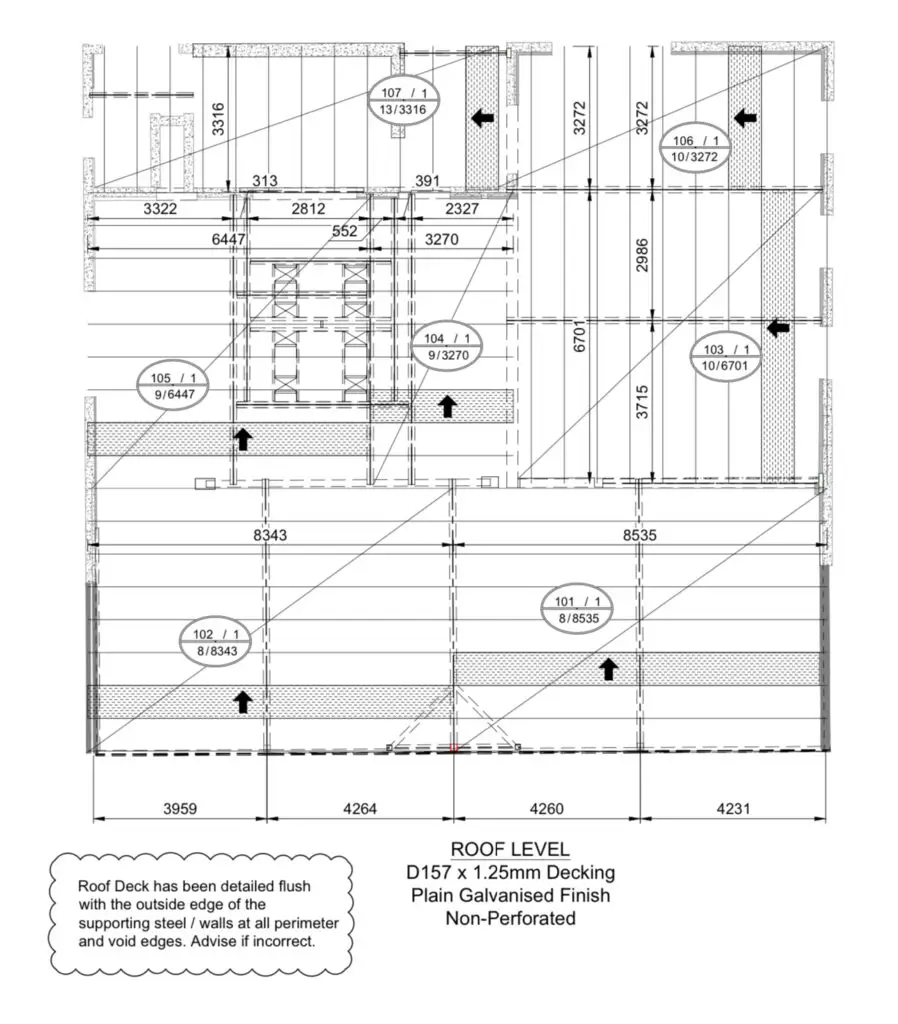
- Plan around cover width: Design floor plates and sheet lengths to minimise cuts and laps. The fewer laps, the faster the pour (TR60+ shines here at 1,000 mm).
- Concrete economy: Deeper trapezoidal ribs and re-entrant dovetails displace concrete. Over 1,000 m², expect several m³ less concrete than an equivalent flat slab, worth it for crane loads, curing time and cost.
- Fixings: On non-composite infills, X-ENP-19 nails are a proven, fast option to steel primaries. In composite work, studs govern; detail stud positions (central in troughs), many profiles place stiffeners to make this easy.
- Set expectations on speed: Hitting ~400 m²/day assumes one level, square edges, clear access, sensible sheet lengths, minimal penetrations and no propping. Breaks in geometry, service openings or wet/windy days will slow it down.
Where RMD Profiles helps
- Design + calcs: British or Eurocode/SCI-aligned composite/slab design, vibration checks and fire design.
- Drawings + layouts: Clear GA and decking layouts to reduce clashes and speed installation.
- Supply-only or supply-and-fix: UK stock, stud welding, nets and edge protection as needed.
- On-the-day problem-solving: Quick design tweaks when site reality changes.