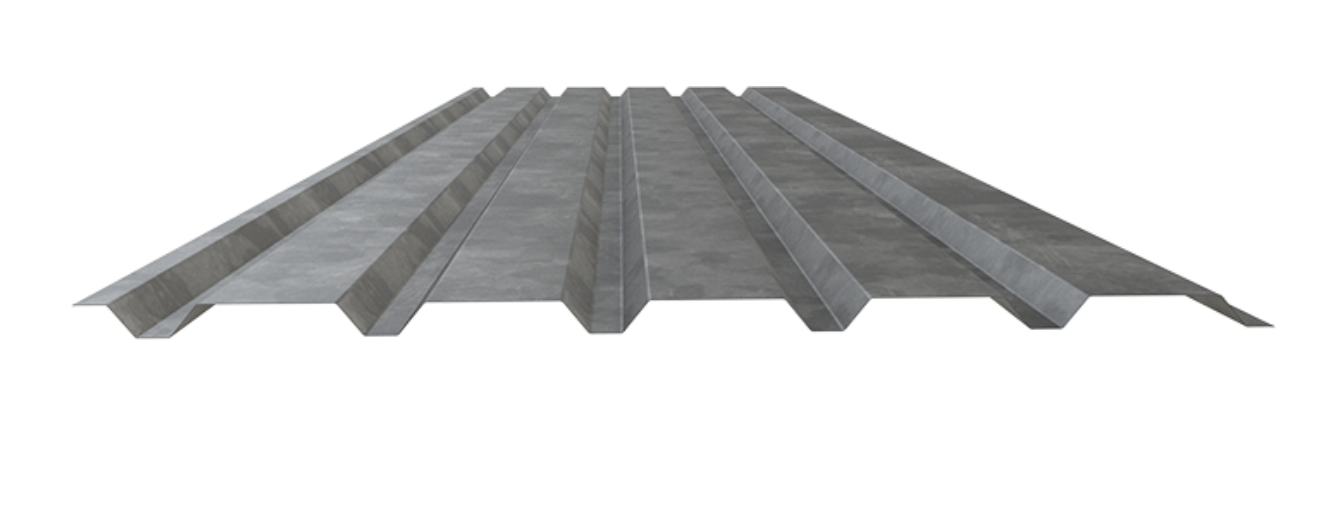

The shallowest corrugated roof decking engineered for short spans, canopies and light structures – this Metal Roof Deck spans 1000mm cover width maximises coverage rate and minimises joints.
Key Facts of SR30+ Metal Roof Deck
- Profile depth: 30mm | Pitch: 200mm | Crown: 121mm
- Available gauges: 0.7mm & 0.9mm steel (S350)
- Maximum sheet length: 12 metres
- Typical span range: 1.0m–2.3m
- Galvanised or polyester coated
SR100+ Steel Roofing starts from £9 per square meter for supply only.
Ideal Applications for SR30+ Steel Roofing
Agricultural Buildings
Lightweight, fast-fixing roof for grain stores, livestock shelters and farm outbuildings. The shallow profile is economical and the 1000mm cover width reduces fixing points.
Light Industrial
Ideal for workshops, factories and storage sheds. The 2.3m maximum span handles typical purlin spacings with minimal deflection and excellent cost-to-coverage ratio.
Canopies & Covered Areas
Perfect for external canopies, covered walkways and semi-open structures where weather protection matters more than high strength requirements.
Refurbishment & Over-Cladding
Retrofit existing structures with a lightweight profile that doesn’t add excessive dead load. Easy to cut on site and compatible with most existing purlin spacings.
Why Choose SR30+ Steel Roofing for Your Project
Maximum Coverage
1000mm cover width is the widest in the sinusoidal range, reducing the number of sheets needed and minimising side laps and joins.
Shallow Profile = Lower Cost Metal Roof Deck
The 30mm depth is engineered for short spans (1–2.3m). No over-specification. Lower material weight means less freight and easier on-site handling.
Fast Fixing Metal Roof Decking
Fix at every trough (every 200mm pitch). Wider cover width means fewer fixings per square metre. Industry-standard spaced purlins make installation straightforward.
Two Gauge Options
0.7mm for light loads (canopies, agricultural), 0.9mm for general industrial. Both available galvanised or polyester coated. No over-specification with unnecessary thickness.
Excellent Weather Protection
Sinusoidal profile sheds water faster than trapezoidal. The 121mm crown height creates excellent ridge for water clearance. Side lap not essential on most applications.
SR30+ Steel Roofing Technical Features
Profile Geometry
- Cover width: 1000mm (widest sinusoidal coverage)
- Profile depth: 30mm (shallow, lightweight design)
- Pitch (wave length): 200mm
- Crown height: 121mm (excellent water shedding)
- Valley depth: 30mm
- Maximum sheet length: 12 metres (minimises end laps on longer spans)
Material & Coating Options
- Steel grade: S350 (minimum yield 350 N/mm²)
- Gauges available: 0.7mm | 0.9mm only (no 1.2mm)
- Galvanised: Z275 (275g/m² zinc dual-sided coating, 15–25 year durability)
- Polyester coated: White 150g/m² Z150 base (25+ year durability, enhanced aesthetics)
- Fire performance: Class 1 | Class 0 (subject to insulation and final assembly)
Span & Deflection
- Typical span range: 1.0m–2.3m (based on 0.9mm gauge, deflection Span/200)
- Deflection limit (default): Span/200 for most applications | Span/90 for more rigid structures
- Load factor: 1.5 safety factor applied
- Bearing length: Minimum 60mm on purlin
- Typical purlin spacing: 1.0–2.0m centres (design-dependent)
SR30+ Steel Roofing Section Properties
| Gauge | Weight (kg/m²) | Area (mm²/m) | Top MoC (kNm/m) | Top MoI (×10⁶mm⁴/m) | Bot MoC (kNm/m) | Bot MoI (×10⁶mm⁴/m) |
|---|---|---|---|---|---|---|
| 0.7mm | 6.66 | 805 | 1.45 | 6.2 | 1.54 | 9.5 |
| 0.9mm | 8.57 | 1049 | 2.19 | 8.8 | 2.18 | 13.2 |
Note: MoC = Moment of Capacity (plastic section modulus). MoI = Moment of Inertia. Values per linear metre of sheet. Consult design calculations for actual load-bearing on your specific structure.
SR30+ Steel Roofing Design & Specification
Fixing & Lap Requirements of SR30+ Metal Roof Deck
- Fixing points: Every trough (200mm pitch). No intermediate fixings needed—the wide 1000mm cover reduces fixing density.
- End lap: Minimum 150mm. Use end lap plates or sealant as required by exposure and insulation type.
- Side lap: Not essential on most applications. Where required (e.g., high wind uplift), use self-drilling screws or mechanical fasteners.
- Side supports: Maximum spacing 450mm centres (purlins or side rails). Closer spacing improves edge stiffness.
- Bearing length: Minimum 60mm clear bearing on purlin. End plates recommended for larger installations.
Purlin Design Considerations
- Purlin spacing: Typically 1.0–2.0m centres. Check with structural engineer for wind uplift, live loads and deflection.
- Closely spaced purlins: Enable longer spans and lighter sheet gauges. Ideal for cost optimisation on new builds.
- Existing structures: If retrofitting over old purlins, verify existing spacing doesn’t exceed maximum 2.3m.
- Bracing: Ensure adequate lateral bracing per building code. Purlins must be designed as composite with the sheet.
Material Handling & Storage
- Store flat on level, dry ground with air gap beneath (prevent corrosion from moisture trapping).
- Cover with breathable sheeting if stored outdoors for extended periods (galvanised develops white rust if exposed to salt air).
- Maximium 12 metre lengths: handle with care to avoid kinks. Use soft slings on crane.
- Polyester coated sheets: avoid harsh cleaners. Rinse with fresh water and dry thoroughly.
Installation Guide
Step 1: Preparation & Layout
- Check all purlins are level and aligned. Install any drift bracing per structural drawings.
- Mark out sheet positions. Plan layout to minimise end laps and waste (12m maximum length allows long uninterrupted runs).
- Install eaves trims and gutter before roofing begins.
- Position insulation quilt (if required) and install self-supporting battens or purlin clamps.
Step 2: Fixing Pattern
- Fix every trough (every 200mm). Standard 10–12mm domed washers with neoprene seals to suit gauge.
- For 0.7mm: use 5.5 × 25mm self-drilling screw | For 0.9mm: use 6.3 × 25mm (or 5.5 × 32mm for deeper bearings).
- Do not over-tighten. Washers should compress slightly but not extrude from beneath head.
- Use stainless steel fasteners on polyester coated sheets, galvanised or stainless on bare galvanised.
Step 3: End Laps
- Minimum 150mm overlap when sheets butt end-to-end. Install end lap plates (tray-shaped) underneath or use compatible sealant.
- Fix through end lap into purlin with additional fasteners as required by wind loading and exposure.
- Seal end laps with compatible polyurethane or bitumen sealant to prevent water ingress and dust accumulation.
Step 4: Side Laps & Edges
- Side lap not essential on most light-industrial and agricultural applications. Check wind uplift calculations.
- If side lap fastening required, use a staggered pattern (alternate troughs, alternate sides) to prevent water pooling.
- Install edge trims and verge closers to neaten edges and prevent wind up-lift at perimeter.
Step 5: Safety & Completion
- Inspect all fixings for corrosion or misalignment. Re-tighten where washers have settled.
- Clean off any swarf or debris. Polyester coated sheets: rinse with fresh water to remove cutting residue.
- Ensure all flashings, valleys and gutters are sealed and draining correctly.
- Install roof safety systems, walkways or barriers as required by building code and access frequency.
Problems Solved by SR30+
Excessive Roofing Costs on Short-Span Buildings
Heavy gauges (1.2mm+) are over-specified for spans under 2m. SR30+ at 0.7mm or 0.9mm delivers adequate strength at lower material cost. Lower weight = reduced freight and easier assembly.
Too Many Roof Joints & Water Ingress Risk
1000mm cover width is the widest sinusoidal profile available. Fewer side laps, fewer end joints = simpler construction, better weather sealing and faster assembly with fewer fixings per m².
Poor Water Drainage on Old Shallow Roofs
Sinusoidal profile sheds water faster than trapezoidal. The 121mm crown height and 30mm valleys create efficient drainage paths, reducing pooling and extending roof life in wet climates.
Retrofitting Over Existing Structures Without Overloading
The lightweight shallow profile minimises dead load on old timber or steel frames. 0.7mm gauge at 6.66 kg/m² is ideal for over-cladding without structural reinforcement.
Complex Geometries & Large Sheets Difficult to Handle
Available in lengths up to 12 metres, SR30+ accommodates most roof slopes in a single continuous sheet, reducing end laps and on-site cutting. Lighter gauge = easier manual handling and safer crane operations.
Corrosion on Uncoated or Poorly Maintained Roofs
Galvanised Z275 (275g/m² dual-sided) provides 15–25 year durability in most UK climates. Polyester white coating extends this to 25+ years. Both specifications offer cost-effective long-term protection without premium materials.
RMD Services for Your Metal Roof Decking Project
Layout Drawings
Structural engineers produce detailed layout, cutting plans and fixing schedules for your specific roof geometry. Includes load paths, end laps, eaves details and interface with existing structure.
Supply and design service. Contact for quote.
Structural Calculations
Full load-bearing calculations (dead, live, wind, deflection, buckling) to EC3 (Steel Construction). Verification of purlin spacing, gauges and fixing patterns for your roof slope and exposure.
Design service. Contact for quote.
CAD & BIM Data
DWG, DXF and Revit families available for architects and engineers. 3D models of SR30+ profile, flashings, trims and accessories for drawing coordination and clash-detection.
Available upon request. Contact for access.
Installation Support & Training
On-site technical support during key phases (fixing, sealing, end laps, flashings). Video tutorials, method statements and team training for your contractors.
Additional costs apply. Contact to discuss scope.
Cut Lengths & Custom Profiles
Factory cut to site-specific lengths (up to 12m) to minimise site waste. Custom coatings or gauges available on bulk orders.
Bespoke manufacturing. Contact for pricing and lead times.
Warranty & Technical Support
Standard 5-year material warranty on all SR30+ sheets. Extended warranty options available. 24/7 technical helpline for on-site troubleshooting.
Included with all products.
SR30+ Sinusoidal Roofing Sheet — RMD Profiles UK
SR30+ is a shallowest sinusoidal roofing profile designed for short spans (1–2.3m), light industrial buildings, agricultural structures, canopies and over-cladding. Engineered with 1000mm cover width, shallow 30mm depth and available in 0.7mm or 0.9mm gauges. Galvanised Z275 or polyester white coated. Fast-fixing, excellent water drainage and cost-effective for minimal load applications.
Frequently Asked Questions
What is the maximum span for SR30+ Steel Roofing?
Typical maximum span is 2.3m for 0.9mm gauge under standard deflection limits (Span/200). The 0.7mm gauge suits spans up to ~1.8m. Always consult structural calculations for your specific load case (wind uplift, live load, snow, etc.). Purlin spacing must match the roof pitch and exposure zone per your building code.
Can I use SR30+ on a low-pitch (flat) steel roof?
Yes. The sinusoidal profile sheds water effectively down to very shallow pitches (as low as 2°). However, on truly flat roofs (0–2°), ensure all gutters and valleys are clear of debris, and consider mechanical fastening (side lap screws) to prevent wind uplift. Always verify with structural engineer.
Do I need to sealant the side laps?
Not essential on most applications. The corrugated roof decking is 1000mm cover width minimise water pooling at side laps. However, on north-facing slopes, in very wet climates or where side lap fastening is required, apply compatible polyurethane or silicone sealant for extra security.
What gauge should I specify-0.7mm or 0.9mm?
0.7mm for light applications (canopies, agricultural sheds, short 1–1.5m spans). 0.9mm for general industrial use, longer spans (1.5–2.3m) and higher wind exposure. Your structural engineer will confirm based on purlin spacing, loads and deflection limits. Neither gauge is over-specification for short-span design.
Is galvanised or polyester coated better?
Galvanised Z275 (standard, 15–25 year durability): Economical choice for most UK climates. White rust (zinc corrosion) is cosmetic; doesn’t affect structural integrity. Polyester white (25+ years): Premium finish for exposed, high-visibility structures or aggressive environments (coastal, industrial). Maintain both coatings by rinsing with fresh water annually.
What fasteners should I use on the SR30+ corrugated roof decking?
For 0.7mm: 5.5 × 25mm self-drilling screw. For 0.9mm: 6.3 × 25mm or 5.5 × 32mm (deeper purlin). Always use 10–12mm domed washers with neoprene seals. On galvanised sheets, use galvanised or stainless fasteners. On polyester coated, use stainless. Never use bright steel (rust risk).
Can I cut and fit on site?
Yes. SR30+ cuts easily with tin snips, grinders or portable cold saws. Always wear safety gear and gloves (sharp edges). Remove any burrs with a file. Seal cut edges with touch-up paint or zinc-rich primer to prevent corrosion at the cut surface, especially on galvanised sheets.
How do I fix SR30+ corrugated roof decking over insulation?
Install insulation quilt (fiberglass, polyurethane or mineral wool) directly on purlins or structural deck. Lay self-supporting battens or purlin clamps over the insulation to create a direct bearing surface. Fix SR30+ through battens into purlins below. Ensure adequate ventilation above the insulation layer (minimum 50mm air gap) to prevent condensation. Consult with insulation supplier for compatibility.
What is the Class 0 / Class 1 fire rating?
Class 0 and Class 1 are UK fire performance classifications for roof materials. Steel sheeting alone is non-combustible (Class 0). The rating depends on the complete assembly (sheet + insulation + membranes). Ask your insulation supplier to confirm the fire rating of your complete roofing system. Building Regulations may require Class 0 for certain building types.
Do you offer bespoke gauges, coatings or lengths?
Standard products: 0.7mm, 0.9mm only. Standard coatings: Galvanised Z275, Polyester White 150g/m² Z150. Custom gauges, colours and cut lengths are available on bulk orders. Contact our sales team with your requirements for a formal quotation.
Ready to Specify SR30+ for Your Metal Roof Deck Project?
Let our engineering team help you optimise your roofing design. Fast turnaround on layouts, calculations and quotations for corrugated roof decking.